News

Beyond the Diagnosis: How Food and Transportation Barriers Affect Lupus Care

Beyond the Diagnosis: How Food and Transportation Barriers Affect Lupus Care

September 2026 | Lupus Research & Health Equity

For individuals living with lupus, managing the disease often involves challenges that extend far beyond medical treatment. Access to nutritious food, reliable transportation, stable housing, and financial resources can significantly influence a patient’s ability to maintain consistent healthcare and overall well-being.

A study published in the September 2026 issue of Arthritis Care & Research highlights the relationship between economic insecurity and patient-reported health outcomes among individuals with systemic lupus erythematosus (SLE). The research suggests that identifying and addressing these hardships during medical visits may help improve patients’ quality of life.

Economic Hardships and Lupus Outcomes

Researchers at the University of Wisconsin–Madison examined 222 patients receiving care through specialized lupus clinics. The study evaluated economic challenges involving food, housing, transportation, and finances, along with patients’ assessments of their physical, mental, and social health.

Approximately 16% of participants reported experiencing at least one form of economic insecurity.

Researchers found that greater economic insecurity was associated with poorer patient-reported health, particularly physical health and social functioning.

The findings also suggested a cumulative burden: patients experiencing multiple economic hardships reported progressively worse physical health outcomes.

Why Transportation and Food Security Matter

Lupus is a chronic autoimmune disease that can affect multiple organs, including the kidneys, heart, lungs, joints, and skin. Managing the condition frequently requires specialist appointments, laboratory monitoring, medication management, and ongoing medical supervision.

Transportation difficulties can make it harder for patients to attend these appointments, potentially disrupting continuity of care.

Food insecurity presents another challenge. Limited access to nutritious food may complicate efforts to maintain a balanced diet and manage other health conditions alongside lupus.

Financial instability can intensify these difficulties, particularly when patients must balance medical expenses with housing, utilities, transportation, and household necessities.

These interconnected challenges are commonly described as social determinants of health—nonmedical conditions that influence health and access to healthcare.

Addressing Economic Insecurity During Medical Visits

An important component of the research examined whether screening patients for economic hardships and connecting them with social workers could improve health outcomes.

Patients participating in the study were routinely screened for economic insecurity during clinic visits. Those experiencing difficulties could discuss their circumstances with social workers and receive assistance identifying available resources.

Following social work interventions, researchers observed improvements in patient-reported physical health and social functioning. Improvements in mental health were also observed, although they did not reach statistical significance..

Although the findings are encouraging, the observational study does not establish that social work interventions alone caused these improvements.

Nevertheless, the results support the potential value of incorporating social needs assessments into routine lupus care.

Implications for Healthcare Equity

The findings carry important implications for populations disproportionately affected by lupus, including women and certain racial and ethnic minority communities.

Previous research has documented significant disparities in lupus outcomes associated with socioeconomic conditions, healthcare access, and other social determinants of health.

Patients experiencing financial insecurity or limited access to transportation may encounter additional obstacles to receiving timely treatment, particularly when specialist care requires frequent visits.

Integrating social support services into medical settings may offer opportunities to identify these barriers earlier and connect patients with appropriate assistance.

Looking Beyond the Diagnosis

Advances in medical research continue to improve understanding of lupus and expand treatment options. However, effective disease management also depends on patients’ ability to access and sustain appropriate care.

The September 2026 study adds to growing evidence that economic and social circumstances deserve greater attention in chronic disease management.

By identifying challenges involving food security, transportation, housing, and financial stability, healthcare providers may be better equipped to address factors that influence patients’ everyday lives.

The research reinforces an important principle: improving lupus care requires treating the disease while recognizing the broader circumstances that shape a patient’s health.


Research Source

Patel, J., Singh, T., Ingersoll, M., et al. Addressing Economic Insecurities Can Improve Patient-Reported Outcomes in Lupus. Arthritis Care & Research. September 2026; 78(9):1177–1187.

DOI: 10.1002/acr.80000

https://pubmed.ncbi.nlm.nih.gov/41556546/

READ MORE
Lupus research, hydroxychloroquine and cardiovascular heart healthNews

New Lupus Research Highlights Heart Health

New research is offering another important reason for people living with lupus to have informed conversations with their healthcare providers about taking prescribed medications consistently.

A recent study examined the relationship between hydroxychloroquine (HCQ)—one of the most widely used treatments for systemic lupus erythematosus (SLE)—and cardiovascular risk. Researchers studied 248 adults with lupus, looking at hydroxychloroquine blood levels and longer-term medication use.

The researchers found that patients with very low HCQ blood levels and low long-term medication intake had higher estimated cardiovascular risk than patients with greater exposure to the medication. The findings add to growing research examining the relationship between lupus treatment and long-term heart health.

Why Heart Health Matters in Lupus

Lupus is a complex autoimmune disease that can affect many parts of the body, including the cardiovascular system. Understanding and managing cardiovascular risk can therefore be an important part of long-term lupus care.

Hydroxychloroquine has long been a foundational treatment for many people living with lupus. The new research provides another reason for patients and healthcare providers to discuss medication adherence, appropriate monitoring and cardiovascular health as part of an individualized treatment plan.

Turning Research Into Better Patient Conversations

Medication decisions should always be made in consultation with a qualified healthcare professional. Patients should not begin, stop or change the dosage of hydroxychloroquine—or any medication—based solely on the results of a research study.

At The Reid Foundation for Lupus®, we believe access to credible, understandable information can help people affected by lupus become better informed and more engaged in their healthcare. As research continues to advance our understanding of this complex disease, we will continue sharing developments that matter to the lupus community.

Source: Arthritis Care & Research / Yale School of Medicine.

READ MORE
New lupus research on measuring long-term organ damageNews

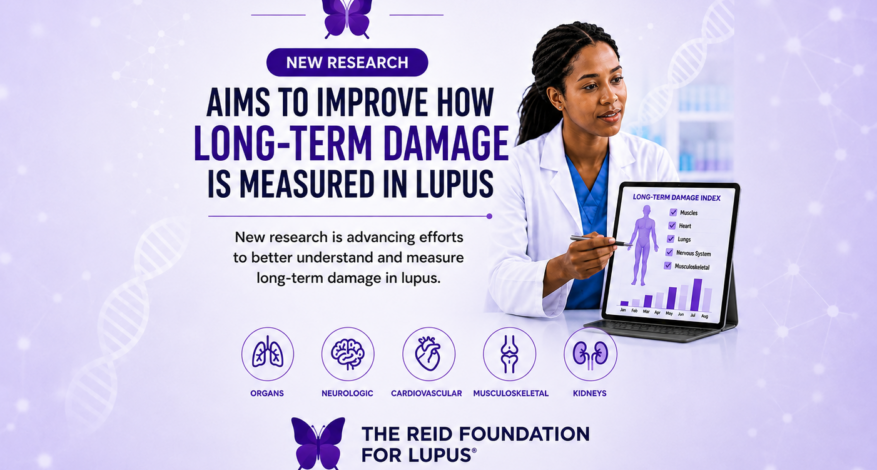
New Research Aims to Improve How Long-Term Damage Is Measured in Lupus

New research is advancing efforts to improve how doctors measure long-term organ damage in people living with systemic lupus erythematosus (SLE).

Researchers are working to modernize the SLICC/ACR Damage Index, a long-standing tool used to assess permanent damage that can develop over time as a result of lupus, its complications or treatment.

As part of the effort, 146 health professionals and people with lupus from 35 countries participated in a consensus process that reviewed 226 potential measures. The group ultimately narrowed those measures to 39 candidates for a proposed updated damage index.

The revised approach is intended to better reflect today’s understanding of lupus and current standards of care. Researchers are also considering how different types and levels of damage should be weighted so that the index can more accurately capture the long-term impact of the disease.

The updated index is still being developed and tested. The next steps include refining the scoring system and evaluating the revised tool for validity, reliability and responsiveness before it can be considered for broader use.

For people living with lupus, more accurate ways to measure long-term damage could help researchers and healthcare providers better understand disease progression, compare outcomes and improve future care.

For additional information, read the full research summary from the Lupus Foundation of America.

READ MORE
Artificial intelligence and lupus care researchNews

Artificial Intelligence Shows Promise in the Future of Lupus Care

Artificial intelligence is rapidly changing many areas of healthcare, and new research suggests it may also have an important role in the future of lupus care.

A 2026 review published in the medical journal Lupus examined current applications of artificial intelligence in systemic lupus erythematosus (SLE). Researchers evaluated how AI and machine-learning technologies are being studied to assist with diagnosis, monitor disease activity, predict flares and organ-specific complications, and potentially help personalize treatment.

Because lupus can affect people differently and symptoms and disease activity can change over time, identifying patterns that may help physicians anticipate changes in a patient’s condition could be particularly valuable. The review found promising developments in areas including flare prediction, cardiovascular risk assessment and the analysis of kidney biopsies related to lupus nephritis.

However, researchers emphasized that significant work remains before these technologies can become part of routine lupus care. Many AI models still require broader validation, greater transparency and testing across more diverse patient populations. The review also reports that no AI tool evaluated for SLE has yet received regulatory clearance.

For people living with lupus, these advances offer an encouraging look at how technology may eventually support earlier detection of changes in disease activity and more individualized care. Continued research will be essential to ensure that these tools are accurate, clinically useful and equitable for the diverse communities affected by lupus.

For additional information, read the full research abstract and publication details on PubMed.

READ MORE
Kentucky Colonel commission honoring Bryant Reid by Governor Andy BeshearNews

Bryant Reid Honored as a Kentucky Colonel by Governor Andy Beshear

The Reid Foundation for Lupus® proudly recognizes Founder and Board Chair Bryant Reid’s commission as a Kentucky Colonel, one of the Commonwealth of Kentucky’s highest honors. Reid was commissioned by Kentucky Governor Andy Beshear in recognition of his distinguished record of professional achievement, leadership, public service and contributions to the community.

Over a career spanning more than three decades in entertainment, Reid has helped shape the careers of major recording artists and contributed to projects with lasting cultural impact. Alongside his professional accomplishments, he has maintained a strong commitment to advocacy and community service, particularly through his work on behalf of individuals and families impacted by lupus.

Through The Reid Foundation for Lupus®, Reid continues to advance awareness, education, patient support and access to resources for communities in need.

For additional coverage of Bryant Reid’s Kentucky Colonel Commission and career of service, read the feature in The Kentucky Journal.

READ MORE
News

Vents Magazine Spotlights Bryant Reid and the Reid Foundation for Lupus®

Q1.

You’ve been honored with both the President’s Lifetime Achievement Award for over 4,000 hours of volunteer service and the Kentucky Colonel Commission for outstanding community leadership. How do you see the connection between your legendary work discovering artists like Usher and Toni Braxton at LaFace Records and your current philanthropic mission through The Reid Foundation for Lupus®, and what drove you to transition from music executive to community advocate?

Bryant Reid:
There’s definitely a connection between my work in music and my work in philanthropy. In both cases, it’s about service — giving people opportunities, creating platforms, and helping them realize their potential. At LaFace, it wasn’t just about signing acts; it was about cultivating talent at every level. I gave opportunities to unproven artists like Usher, producers and songwriters like Jermaine Dupri before he had those monster hits with Mariah Carey and Kris Kross, and even Vincent Herbert before he went on to work with Lady Gaga and Tamar Braxton. I empowered them when they were still unproven and gave them a chance to shine. That was service.

When I was diagnosed with lupus, I understood it as more than just a personal challenge — . God had blessed me with an extraordinary career and life, and I knew it was time to use that platform in a different way. That’s what drove me to start The Reid Foundation for Lupus®. The same instincts I used to recognize and empower talent in music, I now use to build a foundation that can help communities and people in need of resources and hope.

Q2.

In that memorable BET interview, a teenage Usher credited you as the person who recognized him and brought him to LaFace Records, calling you “L.A. Reid’s brother” and head of A&R. As someone honored as Executive MVP at LaFace, what specific qualities did you look for when discovering talent, and how did your visionary instincts—like personally approving an emerging Jay-Z for the Braxtons—help you identify artists who would shape culture before they became household names?

Bryant Reid:
For me, talent has to pop off the screen. I don’t care whether it’s music, sports, or fashion — it’s gonna pop off the screen. With singers, sometimes a great tone is even more powerful than technical perfection. And just to be clear, I’m not saying I discovered her, Just listen to Sade- She’s so special. When you hear her, it’s magical. Her tone and stage presence create the environment. That’s what makes her unforgettable.

When it came to Usher, I’ll never forget seeing him perform as a teenager — he popped off the screen immediately. In that early BET interview, he mentioned me by name, and I’m glad that moment is on record. I called my brother L.A. and said, “I just saw this singer — he’s a combination of Bobby Brown and Michael Jackson.” L.A. said, “Get him up to the office.” That’s how it went down — and the rest is history.

And then there was Jay-Z. The Braxtons had a single, “So Many Ways.” We needed a remix, and his name came up. I didn’t just roll with it. I got some material, I listened, I did my research — and I knew he was the one. He delivered on that remix, and later, when the Lady of Soul Awards came around, I wanted Jay-Z to perform it with the Braxtons on that stage. He agreed, and he pulled it off. Looking back, I’m glad I trusted my instincts, because that was early Jay-Z — before he was a household name — and to see what he became is incredible.

That’s always been my approach. I wasn’t chasing trends. I was recognizing the people whose tone, style, and presence popped off the screen and told me they weren’t just good — they were going to shape culture.

Q3.

Your work helped establish Atlanta as a global music capital through artists like TLC, OutKast, and your television series B-Street Live, which featured future stars like CeeLo Green and Rasheeda Frost before they achieved fame. How did you recognize Atlanta’s potential as a cultural epicenter in the 1990s, and what role did your ability to spot pre-fame talent play in building what you call “movements that heal communities”?

Bryant Reid:
In the early ’90s, a lot of people in the industry were still looking to New York, Los Angeles, or maybe Chicago when they thought about music. But I saw something in Atlanta that others overlooked. The city was already rich with rappers, singers, songwriters, and producers. Atlanta had energy — bass rap, cool rappers, and a deep creative pool — but what it didn’t have was a major outlet. There wasn’t a brick-and-mortar record label based in the city that could take all of that raw talent and give it a true platform. That’s one of the most important things LaFace Records provided: an outlet for the talent that was already here.

Once that door opened, it exploded. You had producers like Jermaine Dupri, Dallas Austin, and Rico Wade, who each brought their own creativity and helped fuel LaFace’s growth. And you had acts like TLC and OutKast who, together with the label, helped Atlanta step onto the global stage. We didn’t have a set “sound” in the beginning — what we did was create our own thing. We created our own movement. We became the Motown of the South, and that movement carried Atlanta into history.

That same spirit of vision carried into television with B-Street Live. My idea was simple but bold: how can I bring signed talent, unsigned talent, A-list musicians, rappers, singers, dancers, and celebrity hosts all into one room, on one stage, for one night? That was my vision. Turner Broadcasting executives came out to see it live, and the night was unforgettable. It was different, it was fresh, it was electric — truly groundbreaking. They told me right then, “Don’t even worry about finishing the pilot. Let’s go to contract.” And B-Street Live was born.

And just like with LaFace, I used B-Street Live to give opportunities. CeeLo Green performed before most people knew his name. Rasheeda Frost — who was already a rapper — I cast as a host, and she did a great job. B-Street Live really gave her that first television platform, and from there she eventually went on to become a familiar face on VH1’s Love & Hip Hop Atlanta. It was a strong look for her, and it showed she could shine on TV as well as in music. And DJ Nabs — one of the fabric DJs of the South — I cast as both the show’s DJ and one of its hosts. He did a remarkable job, and later told me the visibility helped him land a call back into radio. Again, B-Street Live created opportunities.

But the truth is, it was more than just music or TV — it was a movement that healed a community. We saw a shift in the entire city. People finally had an outlet, and it created opportunity. It created jobs. It gave creators a place to be creative. I’ll never forget coming downstairs at the LaFace office and seeing people waiting in the lobby just hoping to meet someone, because they knew something was happening in Atlanta. That’s what an outlet does — it heals frustration and gives hope.

Q4.

The Reid Foundation for Lupus® was inspired by your own delayed diagnosis, and you’ve used your platform for advocacy through keynote addresses, national media appearances, and NBCUniversal’s World Lupus Day virtual event. How has your personal experience with lupus informed your approach to philanthropy, and how do you leverage the relationships and influence you built in the music industry to advance healthcare awareness and community healing?

Bryant Reid:
When I was diagnosed with lupus, I knew immediately there was a deeper purpose behind it. God had blessed me with an incredible career and platform, and I felt called to use that to help others, the way He had helped me. That’s the spiritual foundation of The Reid Foundation for Lupus®.

One of the most important things I’ve done is go directly into underserved communities — what some people might call “getting into the weeds.” I’ve spent time in those neighborhoods, I’ve met the people, and I’ve seen firsthand how badly they need help. Too often, I’ve found that the healthcare system doesn’t treat them with dignity and respect. And when people aren’t treated with dignity, many don’t come back for help at all. That’s unacceptable.

So one of the core goals of my foundation is to change that experience. When people come to us, they’ll be treated with the same respect and value as anyone else — the same as a singer, a rapper, a dancer, an athlete, or a community leader. Everyone deserves dignity. Everyone deserves to be cared for. That’s the philosophy guiding The Reid Foundation for Lupus®.

At the same time, I’m leveraging my relationships in music, television, and entertainment in new ways. We’re building initiatives and fundraising opportunities that bring the creativity of the industry into advocacy — using music, performance, and culture to raise awareness and resources for this disease. It’s forward-thinking, and it’s about bridging two worlds: the entertainment stage and the stage of healthcare advocacy.

It won’t happen overnight, but I believe the same formula that worked in music applies here: create an outlet, build a movement, and let that movement heal communities.

Q5.

You’ve shared the philosophy that “If you know victory, you’ve certainly met defeat,” explaining that true success comes from learning, adapting, and persisting through challenges. Looking at your journey from discovering music icons to receiving the nation’s highest civilian honors, how have the lessons from navigating the music industry’s challenges prepared you for the work of building lasting social impact, and what advice would you give to other creatives and changemakers about balancing professional success with community service?

Bryant Reid:
It took me time, growth, and experience to really understand this: If you KNOW victory, you’ve certainly MET defeat. If you truly KNOW victory, then you’ve also MET defeat along the way. Because if you’re really in the game — if you’re creating, building, competing — it’s not always win-win. And that’s where character gets built. That’s where you learn perseverance.

The truth is, loss can strip people of their confidence, their self-worth, even their sense of purpose. But life is peaks and valleys. That’s true for everyone — whether you’re in business, on a team, creating art, or working a job. If you’re striving for something, there will be disappointments. There will be highs and lows. The question is, what do you do with them? Do you let defeat define you, or do you let it teach you?

For me, those lessons in the music industry prepared me for everything I’m doing now. Whether it was discovering artists, producing a TV show, or building a foundation, I came to understand that setbacks are part of the journey. They make you sharper, more resilient, and more grateful when the victories come.

My advice to creatives and changemakers is this: don’t fear the valleys. They’re part of the process. Use them to learn, adapt, and grow. Don’t measure your life only by the peaks — by the awards, the applause, or the headlines. Measure it by the movements you build that last, and by the people you lift along the way.

And most importantly — you can’t let the highs get too high, or the lows get too low. If a compliment sends you soaring, then a criticism can send you crashing. That’s not balance. The real key is to stay steady, stay focused. Stay humble.


READ MORE
News

TRFL Chair Bryant Reid – Selected for Lifetime Achievement of the President’s Volunteer Service Award

In recognition of his outstanding volunteer contributions in community service to the United States, Bryant Reid was selected for Lifetime Achievement of the President’s Volunteer Service Award. This prestigious recognition is a testament to his steadfast commitment, dedication, and selflessness in serving others throughout his lifetime “His tireless efforts and countless hours of volunteer work, with a primary focus in the area of securing equitable treatment and cures for those with lupus, have undoubtedly made a profound impact on the lives of many individuals and communities. With the 2018 establishment of the Reid Foundation for Lupus, Inc, the impact of his commitment will only continue to expand in the future.


The 2024 awards will be presented in Dallas, Texas, at the annual gala for Anna’s House Domestic Violence Shelter, scheduled to be held on Saturday, October 5, 2024. As a 2024 awardee, Mr. Reid will receive a personalized certificate, as well as a congratulatory letter from the White House, signed by President Joe Biden.”


READ MORE